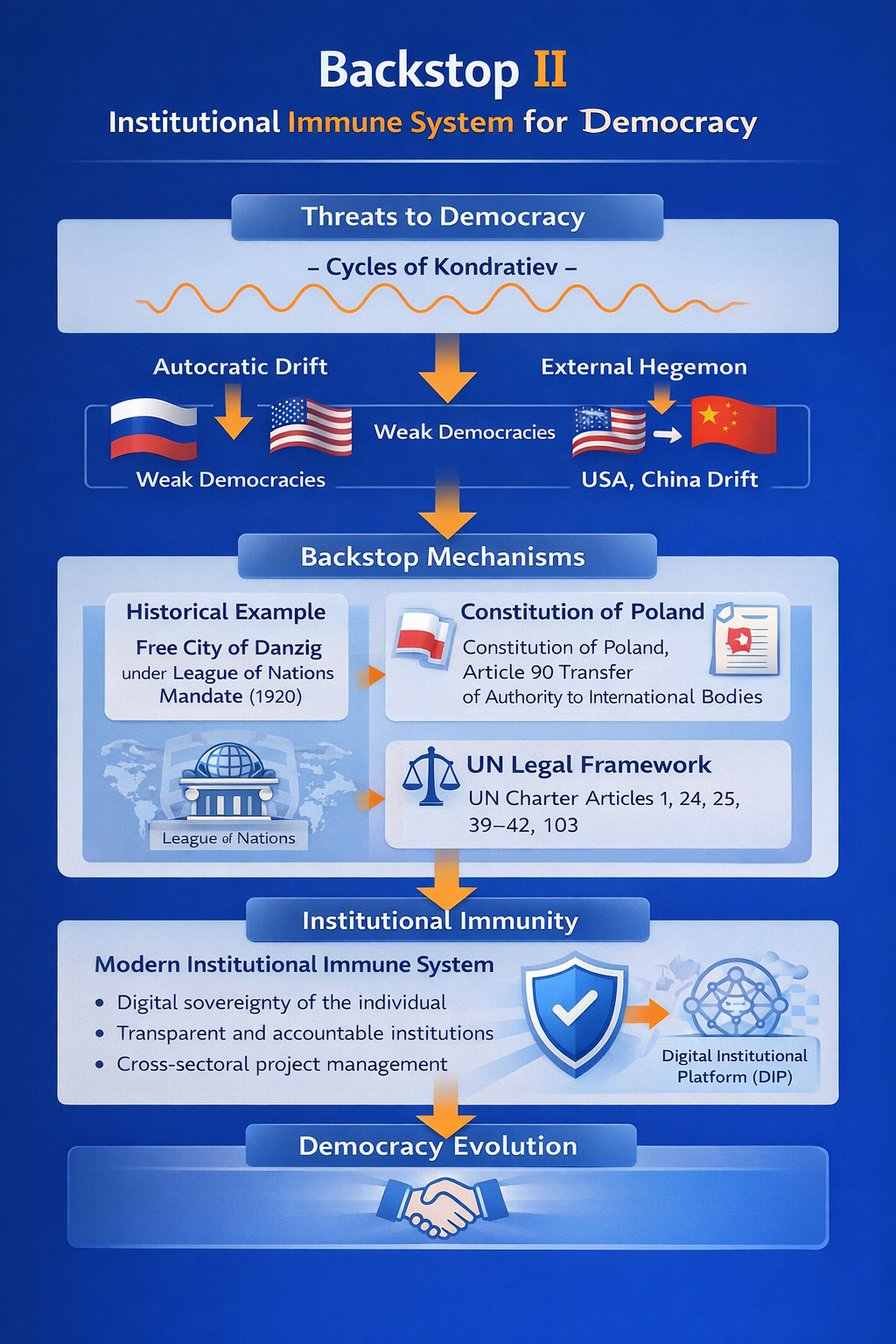
Backstop 2 (Protective Mechanism): Developing an Institutional Immune System for Democracy
Historical experience shows that during periods of deep systemic disruption—economic, technological, and security-related—traditional democratic mechanisms often lose their self-regulatory capacity. Democracies either evolve through the creation of supranational protective institutions or degrade, drifting toward autocracy. As Joseph Schumpeter observed, without structural safeguards, democratic procedures are inherently prone to weakening.
Historical Example of Institutional Protection
One of the first examples of a backstop mechanism was the establishment of the Free City of Danzig after World War I. In 1920, sovereign states agreed to remove a strategically contested territory from direct national control and place it under the mandate of the League of Nations. This was a strategic institutional intervention to neutralize potential conflict.
Constitutional Mechanism for Delegating Authority
Modern democracies provide for similar arrangements at the constitutional level. For example, Article 90 of the Constitution of the Republic of Poland allows the State to transfer competences of state authorities to an international organization or body under an international agreement:
“For certain matters, the Republic of Poland may, on the basis of an international agreement, transfer to an international organization or an international body the competences of organs of state authority.”
Polish Constitution, Article 90
Delegation Mechanisms in the UN Charter
A similar logic is embedded in the UN Charter. Notably:
- Article 1: Member States create the UN to maintain international peace and security.
- Article 24: The Security Council has primary responsibility for maintaining peace and security.
- Chapter VII (Articles 39–42): authorizes the Council to determine threats and adopt binding measures, including sanctions and enforcement.
- Article 25: obliges Member States to implement Council decisions.
- Article 103: establishes the supremacy of UN obligations over any other international agreements.
Limits of Classical Mechanisms
Experience in the 20th and 21st centuries indicates that classical mechanisms often fail at the peaks of Kondratiev cycles, when technological, economic, and power structures shift simultaneously. During these systemic stress points, intergovernmental institutions often become paralyzed, leaving democracies vulnerable to autocratic drift or external hegemonic influence.
The Need for a New Institutional Immune System
The only sustainable solution is the transition to a new institutional security architecture, based on the digital sovereignty of the individual, transparent institutions, and trust-enabling technologies. This system functions as an institutional immune system for democracy — preventing institutional decay, localizing conflicts at pre-crisis stages, and enabling the evolutionary development of democratic models globally.