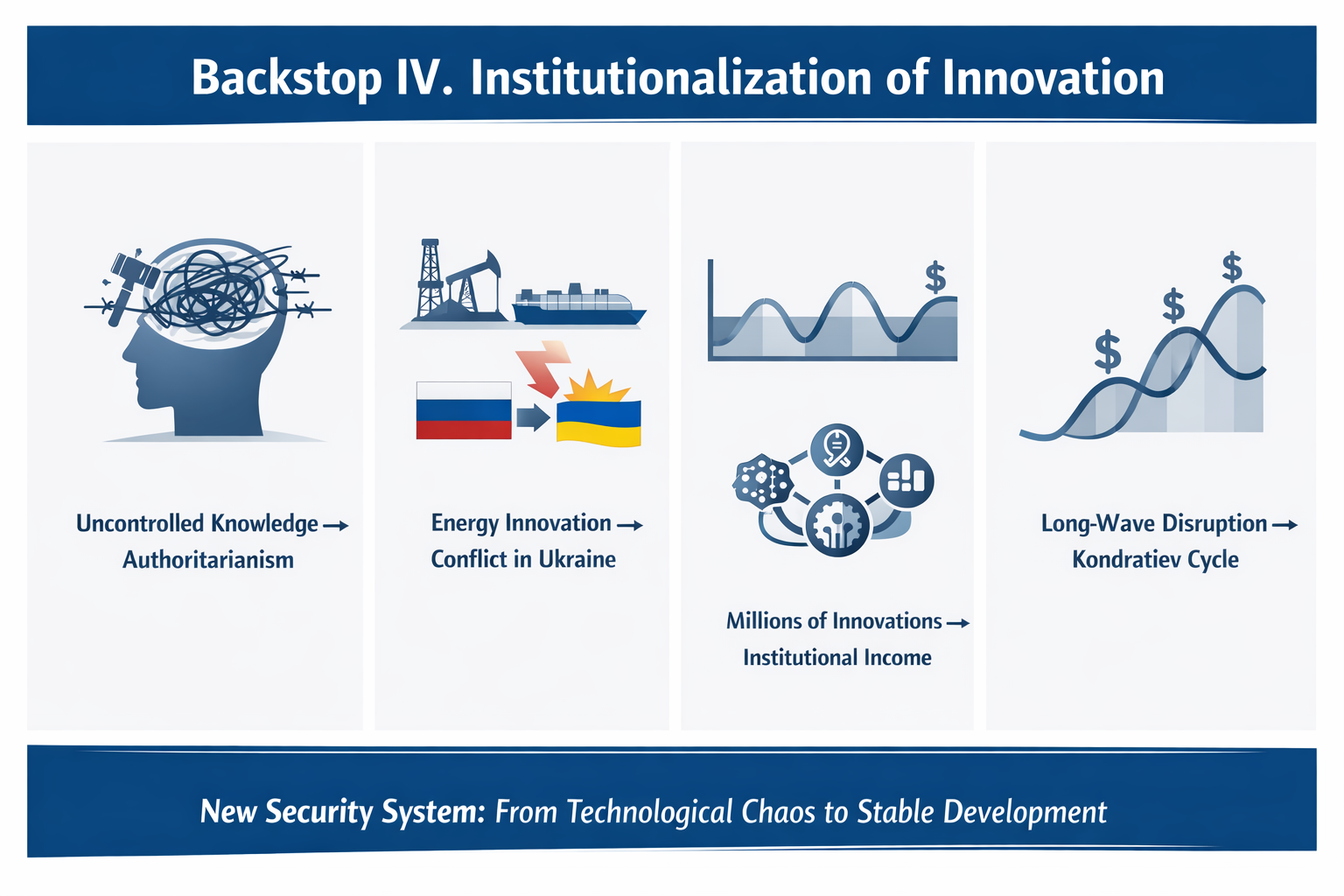
Backstop IV. Institutionalization of Innovation:
Institutional Income - An Expansion of the Economic Model
Unlimited access to knowledge, in the absence of institutional mechanisms for its structuring, inevitably generates authoritarianism as the simplest form of governing complex international processes. Authoritarian systems do not arise as anomalies, but rather as primitive responses to excess, unmanaged complexity.
A contemporary example is innovation in shale gas and oil extraction, as well as liquefied natural gas (LNG) technologies. These innovations became the key factor in displacing authoritarian Russia from the global energy market. This was not primarily about price reduction, but about the loss of Russia’s ability to exercise monopolistic control and political coercion through energy resources.
The result of this displacement was the war against Ukraine, as a form of force-based compensation for the loss of economic and geopolitical rent. Thus, innovation without an institutional safeguard transformed from a driver of economic development into a trigger for a large-scale armed conflict.
This logic fully corresponds to Nikolai Kondratiev’s model of long-wave economic dynamics of capitalist economies, in which technological shifts fundamentally reshape market structures, centers of power, and political stability.
(see Kondratiev wave model)
However, direct analogies are limited. In the classical model, each wave is driven by a single dominant innovation. In the digital era, by contrast, we are dealing not with one innovation, but with millions of parallel, interconnected innovations unfolding simultaneously across finance, artificial intelligence, biotechnology, energy, communications, and security.
Under such conditions, the only viable stabilizing mechanism is institutional income, rather than resource-based or technological rent. Institutional income arises not from ownership of innovation, but from the rules governing its integration into the global system, its safe scaling, and the fair distribution of its effects.
This is precisely the function of a new international security system — not to restrain innovation and not to monopolize it, but to institutionalize its impact. The new international security system becomes the foundational architecture for building a digital society in which innovation ceases to be a source of war and becomes a source of sustainable development.