Basic Model of the Digital Society
TWO-LEVEL GOVERNANCE ARCHITECTURE
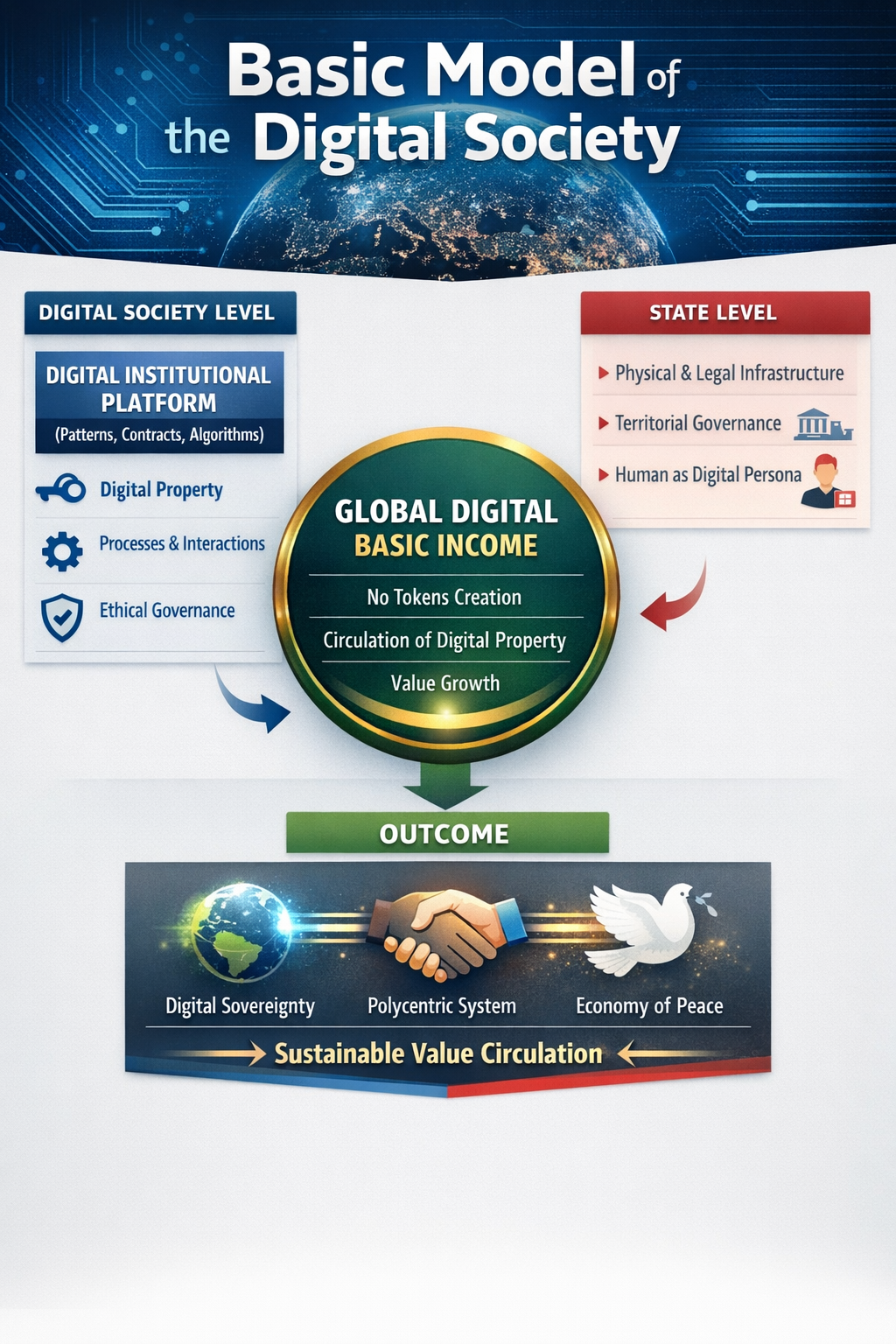
1. LEVEL OF THE DIGITAL SOCIETY (digital layer of civilization)
1.1. Essence
The digital society is represented as the Digital Institutional Platform (DIP) — a global system of self-governance of digital interactions operating on the basis of patterns, digital contracts, and ethical algorithms.
It is not a state and does not replace the state.
It functions as the operating system of civilization.
2. LEVEL OF STATES
2.1. Essence
The state is a territorial institution responsible for the implementation of physical, social, and legal infrastructure.
It does not govern the digital society.
It integrates with the DIP as a physical executor, within which the individual acts as a digital person.
3. CORE INSTITUTIONS OF THE DIGITAL SOCIETY
3.1. Digital Property
Digital property is any digitized object capable of entering into contractual relations.
- assets (energy, land, infrastructure)
- services
- data
- intellectual property
- behavioral patterns
- processes and interactions
This concept is significantly broader than tokenization.
3.2. Global Basic Digital Income (GBDI)
GBDI is a global, automatic basic income generated from the growth of the digital economy and distributed among all individuals as a fundamental right of participation in the civilizational system.
GBDI is a function of the circulation of digital property, rather than the result of its issuance or speculative tokenization.
Within the Digital Institutional Platform (DIP), digital records (tokens) exist as elements of digital contracts operating within a legal framework and secured by real digital property. They do not constitute an independent source of value, but serve as instruments for recording, transferring, and executing rights and obligations within the system.
- there is no issuance of unbacked tokens
- reality is digitized → digital property is formed
- digital contracts and tokenized records ensure its legal circulation
- economic value arises from circulation and interaction, not from the creation of digital units
Thus, GBDI is formed as a natural result of value growth emerging from the continuous circulation of digital property, enabled by contracts and validated within the legal environment of the DIP.
3.3. Source of GBDI: Circulation, not Fees
Key distinction:
- Not: platform fees, taxation
- But: value growth through the acceleration of circulation
$20 trillion of the digital economy → migrates into the DIP → accelerates → generates $20–40 trillion in additional value → fully forms the GBDI fund.
INCOME PER PERSON (GBDI)
| Scenario | GBDI Fund Size | Calculation | Per Person / Year |
|---|---|---|---|
| Minimum | $20 trillion | 20 / 9 billion | ≈ $2,222 |
| Base | $30 trillion | 30 / 9 billion | ≈ $3,333 |
| High | $40 trillion | 40 / 9 billion | ≈ $4,444 |
4. Security
4.1. Type
International security within a two-level system has an inter-systemic nature and is not limited to traditional military mechanisms. It emerges as a property of the architecture of interaction rather than as an external enforcement tool.
Its foundation lies in the stability of digital connections, transparency of operations, and verifiability of ethical patterns.
4.2. Source
Security arises from economic inclusion within a shared system of value circulation. The higher the interdependence, the lower the conflict motivation.
5. Peace as a Function of the System
Peace is not a political agreement but a systemic outcome. As integration grows, war loses its economic and institutional rationale.
6. Ideology Without Ideology
The system does not impose beliefs but defines rules of interaction. Different value systems coexist without conflict.
7. Civilizational Outcome
A global economy of continuous value circulation emerges, along with digital sovereignty and a polycentric world without dominance.
8. General Formula
(Digital Person + Digital Property + Contracts + Cross-Signals)
× Polycentric Institutions → GBDI → Peace
9. Key Conclusion
The digital society is not the digitization of the existing world, but a new form of civilizational organization unifying economy, law, and governance.